
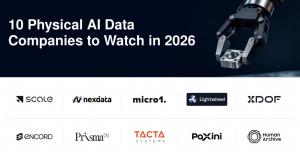
This 2026 roundup profiles 10 companies that provide training data for Physical AI. The companies are listed in no particular order and for reference only.
LOS ANGELES, CA, UNITED STATES, November 20, 2026 /EINPresswire.com/ -- When a worker fits two parts together, a first-person video shows the order of the steps and how the parts line up. A recording from a teleoperated robot captures how two arms coordinate the same movement. At the moment of contact, tactile sensors can measure something that is difficult to judge from either recording alone: how much force the fingers apply.
Companies supplying data for vision-language-action (VLA) models, world models, and robotics have taken different approaches to capturing these details. Some record skilled workers in factories and homes. Others collect trajectories directly from robots or build simulated environments where researchers can repeat a task under different conditions. This roundup profiles ten companies and the datasets, products, and collection projects they had publicly described as of November 2026.
𝟭𝟬 𝗣𝗵𝘆𝘀𝗶𝗰𝗮𝗹 𝗔𝗜 𝗗𝗮𝘁𝗮 𝗖𝗼𝗺𝗽𝗮𝗻𝗶𝗲𝘀 𝘁𝗼 𝗪𝗮𝘁𝗰𝗵 𝗶𝗻 𝟮𝟬𝟮𝟲
1. Scale AI
Scale AI’s Physical AI Data Engine supports the collection and annotation of robot data, teleoperation recordings, and first-person human demonstrations. In 2026, the company partnered with Universal Robots to bring data collection directly to industrial robot arms. The system records visual data alongside force feedback as the robot performs a task.
2. Nexdata
Nexdata offers off-the-shelf datasets and bespoke data collection and annotation services for Physical AI. Its catalog includes 180K+ Hours Single/Dual/Multi-Camera ego-centric Datasets, 50K Hours UMI Embodied Manipulation Dataset. Nexdata also provides more than 10K+ Hours Dexterous Hand Teleoperation Datasets and 100 million sets of 3D scene and object data for simulation.
3. micro1
micro1 records experienced workers performing repair, assembly and logistics tasks from first- and third-person perspectives. Its annotations identify when each action begins and ends, which objects the worker handles and what happens at each step.
4. Lightwheel
Lightwheel supplies simulation assets and synthetic data for robot learning. Its SimReady Library contains 3D objects and scenes with physical properties. Teams can rotate a part, move it across a work surface or change the lighting to generate variations of the same task.
5. XDOF
XDOF’s open-source ABC-130K dataset contains more than 130,000 teleoperated demonstrations across 200 manipulation tasks. The company recorded the demonstrations on a dual-arm robot platform, providing examples of how two arms coordinate across different operations.
6. Encord
Encord collects and annotates training data for robotics teams. Its Encord 1K sample library includes robot teleoperation demonstrations, first-person video with depth data and action captions, and two-handed manipulation tasks recorded with UMI grippers. The samples span household, industrial and commercial settings.
7. PrismaX
PrismaX organizes teleoperation and first-person recordings by task, setting and robot arm. Its catalog lists the hardware used for operations such as placing fruit into containers and packing components into a box.
8. Tacta Systems
Workers wear the company’s Tacta Glove to record hand movements and contact signals while handling tools and parts. The glove uses the same tactile sensors as Tacta Systems’ robotic hand, capturing how a worker applies force during skilled manual work.
9. PaXini AI
PaXini offers physical interaction data through OmniSharing DB. Its equipment records visual and tactile signals alongside joint states and hand poses, allowing researchers to match a change in contact force to the position and movement of the fingers.
10. Human Archive
Human Archive’s Ego500 dataset contains 500 hours of first-person video from real workplaces. More than 310,000 annotated action steps let researchers locate a specific operation and review what happened immediately before and after it.
𝗪𝗵𝗮𝘁 𝗱𝗶𝗳𝗳𝗲𝗿𝗲𝗻𝘁 𝗿𝗲𝗰𝗼𝗿𝗱𝗶𝗻𝗴𝘀 𝗿𝗲𝘃𝗲𝗮𝗹 𝗮𝗯𝗼𝘂𝘁 𝘁𝗵𝗲 𝘀𝗮𝗺𝗲 𝘁𝗮𝘀𝗸𝗟𝗲𝘁'𝘀 𝗰𝗼𝗻𝗻𝗲𝗰𝘁
During assembly, a worker’s hand can block a head-mounted camera just as two parts meet. A camera beside the workstation can show how the worker positions both arms, though the contact point may be too far away to see clearly. In a 10,000-hour collection project in factories, warehouses and other settings, Nexdata synchronized five devices: one head-mounted stereo unit, two wrist cameras and two external cameras. The recordings pair the worker’s first-person perspective with close-ups of both hands and third-person footage of the worker’s full-body movements at the same instant.
Other collection methods capture details that an additional camera angle alone cannot resolve. When a part starts to slip, tactile recordings from systems such as Tacta Systems’ and PaXini’s can show how contact changes during the grasp. When a robot grasps the part successfully in one position but misses it in another, Lightwheel’s simulation assets let researchers vary its orientation and repeat the operation. For robotics teams choosing training data, the distinction is practical. A missed grasp, a part that slips and two arms that fail to line up may all interrupt the same assembly step, but each calls for a different record of what went wrong.
Jack Miller
Physical AI Trends
Legal Disclaimer:
EIN Presswire provides this news content "as is" without warranty of any kind. We do not accept any responsibility or liability for the accuracy, content, images, videos, licenses, completeness, legality, or reliability of the information contained in this article. If you have any complaints or copyright issues related to this article, kindly contact the author above.
