
Press release[2026-11-25]
AnswerThis Shows Reasons for AI Screening and Risk of Bias Decisions in Systematic Reviews
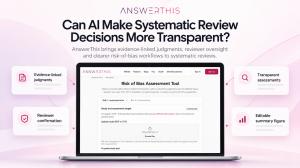
AnswerThis Systematic literature review toolkit
AnswerThis records the reasons for screening and risk of bias decisions, helping reviewers verify each step from eligibility criteria to the PRISMA flow diagram
A systematic review is only as trustworthy as its decisions. AnswerThis makes each judgment traceable, while reviewers remain responsible for the final call.”
— Ayush Garg
SAN FRANCISCO, CA, UNITED STATES, November 25, 2026 /EINPresswire.com/ -- AnswerThis, the AI research assistant backed by Y Combinator, supports systematic reviews from eligibility criteria and search strings through title and abstract screening, full-text screening, data extraction and risk of bias assessment to a PRISMA flow diagram. Each suggested screening decision and risk of bias judgment shows its reason for reviewers to check, and every change is logged. The workflow uses RoB 2 for randomized trials and ROBINS-I for non-randomized studies of interventions, with AI-generated judgments treated as drafts requiring reviewer confirmation.
That visibility addresses a responsibility emphasized in the November 2025 joint position statement from Cochrane, the Campbell Collaboration, JBI and the Collaboration for Environmental Evidence. The statement says evidence synthesists are “ultimately responsible” for their evidence synthesis and that AI should be used with human oversight. It also calls for full and transparent reporting of AI or automation that makes or suggests judgments. This is guidance for evidence synthesis, not an endorsement of AnswerThis.
The importance of checking selection decisions is illustrated by Gartlehner and colleagues’ 2020 crowd-based randomized trial, published in the Journal of Clinical Epidemiology. Across 280 participants and 24,942 screening decisions, single-reviewer abstract screening missed 13% of relevant studies, compared with 3% for dual-reviewer screening. Those findings describe the trial, not AnswerThis’s performance or a universal screening error rate. Cochrane’s MECIR standard C39 requires at least two people working independently to determine study eligibility, while independent duplicate screening at the title and abstract stage is desirable but not mandatory.
Within that human-led process, AnswerThis lets reviewers set eligibility criteria and search strings themselves or revise AI suggestions. The workflow fetches and de-duplicates records and supports title and abstract screening, followed by full-text screening. Reviewers can override suggested decisions and, when full text is missing, upload the PDF and screen it again. Extraction fields can likewise be suggested by AI or added by the reviewer for information such as sample size or a specific outcome.
Those checks continue into appraisal and reporting. Reviewers can open each draft risk of bias judgment to inspect its explanation, while an audit trail records changes. The workflow supports dual or AI reviewer configurations, certainty ratings, a written review draft and exports of individual steps. An AI reviewer does not count as one of the independent people required for Cochrane study-eligibility decisions, and producing a PRISMA flow diagram does not establish compliance with Cochrane methods or the full PRISMA reporting guideline.
Separate website tools let researchers inspect parts of this process. The AnswerThis risk of bias tool for RoB 2, ROBINS-I and QUADAS-2 drafts one study’s assessment per run, checks quotations word for word against the supplied text and removes unverifiable quotations. Its RoB 2 implementation covers individually randomized parallel-group trials, not cluster or crossover trials, and it does not implement ROBINS-I V2 or QUADAS-3. One successful study is free per browser, and every result requires reviewer confirmation.
For extraction, the research paper data extractor with quotations and locations covers up to eight fields, including methods, sample and population, outcomes, effect sizes, limitations, datasets, funding and conflicts of interest. It marks information as found, missing or ambiguous and provides quotations and locations for reviewers to check. It does not recalculate effect sizes. Two papers are free per browser, shared with the AnswerThis summarizer and other extraction tools.
Together, these functions make the decision record available for inspection rather than presenting an unexplained conclusion. Researchers can examine the broader process in the AnswerThis guide to conducting a systematic literature review. The review team remains responsible for checking source evidence, resolving disagreements and reporting how AI affected its methods.
Questions about AI-assisted systematic reviews
How does AnswerThis run a systematic review?
AnswerThis supports eligibility criteria, search strings, de-duplication, title and abstract screening, full-text screening, extraction, risk of bias assessment and certainty ratings through to a PRISMA flow diagram and written draft. Reviewers can change suggested criteria, search strings and extraction fields. Screening decisions and draft risk of bias judgments show their reasons, and changes are logged.
Can AI be used to screen studies for a systematic review?
Yes, with human oversight and a justified process that preserves methodological rigor. The November 2025 joint position statement calls for transparent reporting when AI makes or suggests judgments. AnswerThis shows screening reasons for reviewers to inspect, but an AI suggestion does not replace required independent human eligibility decisions.
How is risk of bias assessed in a systematic review?
Reviewers choose an instrument suited to the study design and the result being assessed. Cochrane recommends RoB 2 for results from randomized trials, with five domains judged as low risk, some concerns or high risk, while ROBINS-I addresses non-randomized studies of interventions. AnswerThis shows the reasons behind its draft judgments so reviewers can check them against the study.
About AnswerThis
AnswerThis (answerthis.io) is an AI research assistant for literature reviews and evidence synthesis. It searches more than 250 million academic papers, drafts reviews with citations that can be checked against their sources, and offers free research tools including a PRISMA 2020 flow diagram generator, a citation generator for 24 styles and a reference checker. AnswerThis is backed by Y Combinator and is used by more than 1 million researchers.
Ryan Mccarroll
AnswerThis.io
ryan@answerthis.io
Visit us on social media:
LinkedIn
Instagram
Facebook
YouTube
TikTok
X
Legal Disclaimer:
EIN Presswire provides this news content "as is" without warranty of any kind. We do not accept any responsibility or liability for the accuracy, content, images, videos, licenses, completeness, legality, or reliability of the information contained in this article. If you have any complaints or copyright issues related to this article, kindly contact the author above.
