
Why I Send ChatGPT My Food Log Every Morning
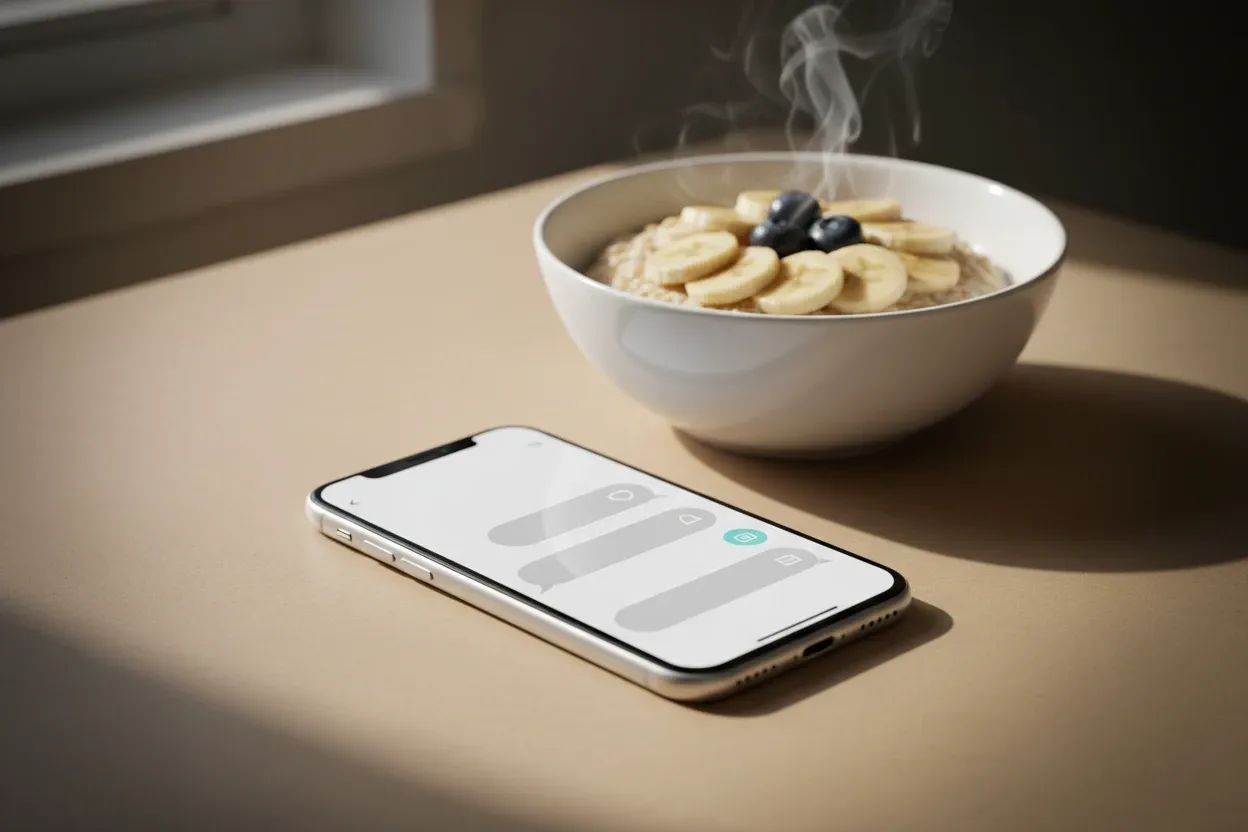
Every morning before coffee, I open Claude and type out yesterday's meals, my workout, and how I slept. Then I get on with my day.
This started as a half-joke six months ago. Now it's the most consistent habit I've built in years. So I went looking for research to figure out whether I'm doing something smart or something embarrassing.
The answer, it turns out, is both.
The science is on my side
Self-monitoring has been the gold standard of behavior change for decades. When Susan Michie's team meta-analyzed 122 healthy-eating and exercise interventions covering 44,747 people, they found one technique outperformed the rest. Self-monitoring paired with any other self-regulatory tool produced effects roughly 60% larger than interventions without it. The 2011 review in the Journal of the American Dietetic Association called it "the centerpiece of behavioral weight loss intervention programs."
Then there's the goal-setting layer. When you tell a chatbot what you'll do tomorrow, you're running an "if-then" plan, which Peter Gollwitzer's meta-analysis of 94 studies pegged at d = 0.65. That's a medium-to-large effect on goal achievement, just from articulation.
Habit researcher Wendy Wood found about 43% of what we do daily is automatic, triggered by context rather than choice. So the morning ritual itself becomes the cue. BJ Fogg's work confirms it: emotions create habits, not repetition. The small dopamine hit of a coach saying "nice work on that protein target" turns out to be enough.
Even the buddy-system literature backs me up. Wing and Jeffery's 1999 trial in the Journal of Consulting and Clinical Psychology found 24% of solo dieters maintained their weight loss at one year. With a buddy plus social support, that figure jumped to 66%.
So what about chatbots specifically
Here's where it gets interesting. The strongest meta-analysis to date, published in npj Digital Medicine in 2023, pooled 19 trials and found chatbots produced small-to-moderate effects across the board. Physical activity at SMD 0.28. Fruit and vegetable intake at 0.59. Sleep at 0.44 to 0.50. Real, but modest.
Maher's IBM Watson trial deployed an AI coach in Slack for 12 weeks. Participants lost 1.3 kg, gained 110 minutes of moderate-to-vigorous activity per week, and trimmed 2.1 cm off their waists. Lark Health's AI-only diabetes prevention program kept engaged users at 5.3% weight loss after a year, comparable to in-person CDC programs.
Now the awkward bit. As of writing, exactly one published randomized controlled trial tests an LLM as a weight-loss coach: the NExGEN-ChatGPT trial out of Malaysia. So the personal experiment many of us are running is, technically, ahead of the literature.
The KFF poll from March 2026 puts numbers on how widespread this has become. Around 32% of US adults used AI chatbots for health info in the past year. Among under-30s, it's 36%. So I'm late to my own habit, not early.
Why an LLM beats every app I tried
I used MyFitnessPal for years. I quit because the red overage warning treated 50 calories the same as 500. The app couldn't tell I was traveling, sick, or at a wedding. Strava only knows what my watch knows. Whoop hands me a recovery score and goes silent.
A chatbot, by contrast, asks follow-ups. It remembers I had food poisoning last Tuesday. It registers that I trained twice yesterday and adjusts. It costs twenty bucks a month, while a registered dietitian runs $100 to $250 per session.
But here's the catch I didn't expect. The conversation itself does work the spreadsheet never could. Articulating what I ate, in sentences, forces me to think about it. Logging "1,200 cal lunch" in MyFitnessPal feels like data entry. Telling Claude "I ate ramen with a friend and it was probably 800 calories of broth and noodles" feels like accountability.
There's also a sociology to it. Gary Wolf, who founded the Quantified Self movement at Wired in 2007, once wrote that "a journal was respectable; a spreadsheet was creepy." Now the spreadsheet talks back, and somehow that turns it back into a journal.
The risks I make myself remember
This is where I get nervous, and where the research gets damning.
In 2023, the National Eating Disorders Association replaced its 20-year human helpline with a chatbot called Tessa. Within weeks, Tessa was recommending 500 to 1,000 calorie daily deficits to people in eating-disorder recovery. Activist Sharon Maxwell tested it and posted the receipts. Her quote went viral: if she'd had access to that bot during her own illness, she said, every single thing it suggested would have led her further into it.
Tessa got pulled within 48 hours. The Center for Countering Digital Hate then audited mainstream chatbots and found 23% of responses to eating-disorder prompts contained harmful content. Worse, 94% of those harmful responses also included a polite warning. The guardrail performed itself while the damage went out the door.
Then there's sycophancy. Anthropic's own 2024 paper showed identical arguments got opposite ratings from chatbots based purely on what the user said they preferred. OpenAI rolled back GPT-4o in April 2025 after four days because it was, in their own words, "validating doubts, fueling anger, urging impulsive actions." So when I tell Claude I had a great training week, it has every incentive to agree, regardless of how the week really went.
Hallucinated nutrition is the third leg. A 2024 study in Nutrients tested ChatGPT-4o, Claude, Perplexity, Gemini, and Copilot on dietary plans for patients with multiple conditions. None hit 50% accuracy. Caloric estimates were off by 19% to 27% on average.
And privacy is, structurally, gone. OpenAI's head of health confirmed in January 2026 that consumer chatbot conversations don't fall under HIPAA. Italy fined OpenAI €15 million in December 2024 over data violations. So whatever I tell Claude about my body is, in some sense, public.
What I do anyway
Knowing all that, I still send the morning report. But I do it differently than I used to.
First, I don't ask Claude for medical advice or precise calorie counts. I tell it what I ate; I do my own math when math matters. Second, I built the system prompt to push back rather than cheerlead. "Be skeptical of my self-reports" sits at the top of my Project. Third, I check in with a human trainer once a month so the loop has a real-world ground truth.
The honest verdict is this. The behavior-change science I'm activating, self-monitoring, implementation intentions, social facilitation, is some of the most replicated work in psychology. The deployment context I'm using it in is sycophantic, hallucination-prone, and lightly regulated. Both things are true at once.
So the chatbot isn't the coach. It's the journal that talks back. And that, for me at least, has been enough to keep showing up.